Editor’s Introduction to World Poetry Review’s Desnos Dossier:
“J’ai tant rêvé de toi.”
I have a strangely detailed memory of my first attempt at translating a poem by Robert Desnos. It's the summer of 2009, it’s late June or early July, and I’m sitting in a square in Bordeaux, a city where strange and unforeseen squares full of restaurant and bar tables appear out of nowhere as you weave through its labyrinthine streets, the four-and-a-half story buildings on either side of you forming an urban Canyon-of-the-Crescent-Moon. I’m working in my notepad with a demi in front of me,and the poem is “J’ai tant rêvé de toi,” first published in 1926, and collected in his 1930 collection Corps et biens (Gallimard). I had read the poem in school, it had stuck with me, and now I’m trying to puzzle through how to make it work in English.
          And I can’t. My rendition is correct, I think, at least close to accurate, but it just doesn’t…sound right.
          Desnos, a semi-mythical Surrealist figure who never made it back from Theresienstadt, has long towered over contemporary French poetry. It’s his unique creativity, even when compared to his Surrealist peers, just as much as his eloquence. The classical streak in him. Perhaps it’s this, alongside his fascination with language and the word, that resonates most for me. His refusal to comply with Andre Breton’s insistence that all Surrealist writing must be automatic, and that the literary forms of the past were to be jettisoned. Much like Raymond Queneau, who split from Breton in 1929, Desnos would show time and time again that established forms could be frameworks for explorations of the unconscious: their familiar shapes and constraints could lead a writer to unexpected and unimagined territory as well as any subconscious effusion or Romantic muse.
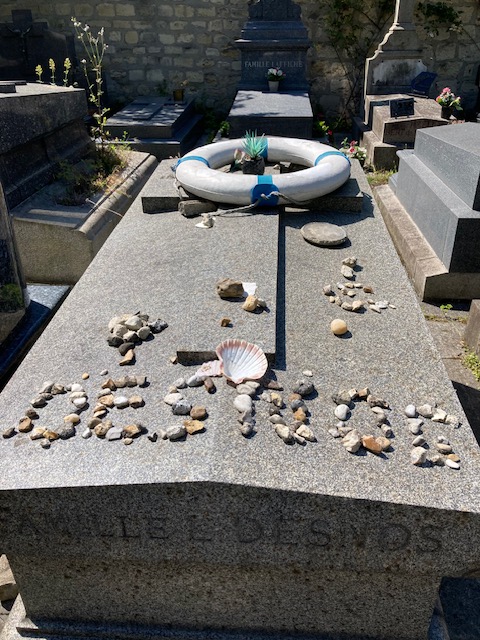
Photo by C. Clarke, Cimitière de Montparnasse, Paris, May 2024
I tried again over the years, at least a handful more times, and there was always something that eluded me. My translations seemed more or less accurate, they followed more or less closely, but the resulting text just didn’t quite work as a poem in English. Something about what made it so beautiful for me in Desnos’s French was eluding me. Typically, I’m one of those translators who will stomp his feet and argue, “Nothing is untranslatable!” I tell my students that untranslatability is only a thing so long as we believe in perfect equivalence between languages, which we don’t. But that isn’t to say that every translation is effective…or that all poetry can be translated with great effectiveness. The aesthetic qualities of certain poems defy us as translators. As for our part in it, literary translation is a choice-driven act. Each choice we make, in its very nature, eliminates or precludes other choices. Leaning toward one quality often forces us to lean away from another. Choosing to focus on one bit of subtext might mask another; to highlight one particular nuance or semantic suggestion might weaken a rhythm or make impossible an assonance or internal rhyme. And yet, I don’t expect all translations to be perfect, nor do we need them all to be completely effective. Even flawed, they can still play a role in our reading and understanding. I’ve long felt, to the detriment of my bookcases, that the best way to truly engage with and understand foreign literature isn’t by holding out for perfect translations, but instead through translational accumulation. Reading multiple translations of the same text can allow us to map out the different choices, to touch different corners of nuance, to explore the gradients of literary art. To peek through the cracks, so to speak. Unfortunately, in the world of contemporary publishing, this is often reserved for the classics, because for a certain span of time the conventions of copyright prevent us from allowing translations to proliferate. I’m not the first to notice this issue. In a letter to New Directions publisher James Laughlin in October 1971, as they worked at assembling a new collection of work by the great Mexican poet Octavio Paz, the poet-translator Muriel Rukeyser wrote, “My work has for some time taken me toward a position in which I welcome all good translations […] Until now, it has been impossible to get the variousness I care about through the laws of property.” Eventually, however, if we are patient, the public domain comes to our rescue. If we’re still curious after enough time has passed, we can employ this variousness to glimpse through the cracks and peer around the corners. First published 99 years ago, this poem by Robert Desnos is now susceptible to such an exploration. I’ve long wanted to do this, but I’ve had to wait. And so, for your reading pleasure, I reached out to friends and colleagues of the translation world who translate poetry from French and set them all to the task. I let them know ahead of time that I felt this poem to be particularly resistant, and that I have never been entirely satisfied with its translations, either my own efforts or previously published versions I have read. Translate it anyway, I said, and see what happens. We will read by accumulation. I also invited these translators to append some notes or commentary describing what they encountered, if they had time. Some have, others have not. Enjoy, then, these fourteen translations, including my own most recent effort. I think this accumulation can be of interest to monoglot Anglophones and francophiles alike. Read them closely, and read them together, stacked one over the other; their variousness offering your mind a Venn diagram of nuance. Perhaps through this accumulation, you may absorb some of what so resists poetic translation in this lovely poem that was written nearly one hundred years ago, during the peak days of French surrealism.
A special thanks to the many talented translators for contributing to this accumulative experience. If all goes according to plan, I’ll have a special bonus version ready to add in a few weeks’ time, once I work out the tech hurdles to displaying it in the way I’ve imagined it. Stay tuned!

 World Poetry Review